Key Takeaways
- "Just relax" does not work because flight anxiety is processed by the survival brain, which cannot be reached by rational thought alone.
- The 4-7-8 breathing technique activates the vagus nerve and can shift your nervous system from fight-or-flight to calm within 60-90 seconds.
- Grounding techniques (5-4-3-2-1 method) redirect your brain from internal panic to external reality.
- Turbulence is uncomfortable but has never caused a modern commercial aircraft to crash (FAA/NTSB data).
- Your body's panic response is a false alarm - your nervous system is doing its job, it is just doing it in the wrong place.
- Real-time expert support via SkyBuddy or the SkyGuru app can make the difference between white-knuckling through a flight and actually managing it.
- Medication can help short-term, but it does not teach your nervous system that flying is safe - which means the fear stays.
Why "Just Relax" Is the Worst Advice You Can Get
If you have ever been told to "just relax" on a plane, you know how useless - even infuriating - that advice feels. There is a neurological reason for this, and understanding it is the first step toward actually calming down.
When your brain perceives danger (even if no danger exists), it activates the amygdala - the alarm system deep in your survival brain. This triggers a cascade of stress hormones: adrenaline floods your bloodstream, your heart rate spikes, your breathing becomes shallow, your muscles tense, and your palms sweat. This is your fight-or-flight response.
Here is the critical point: your thinking brain (prefrontal cortex) goes partially offline during this response. The survival brain takes over. This is why you cannot think your way out of panic. You cannot reason with a fire alarm - you have to turn it off through the body.
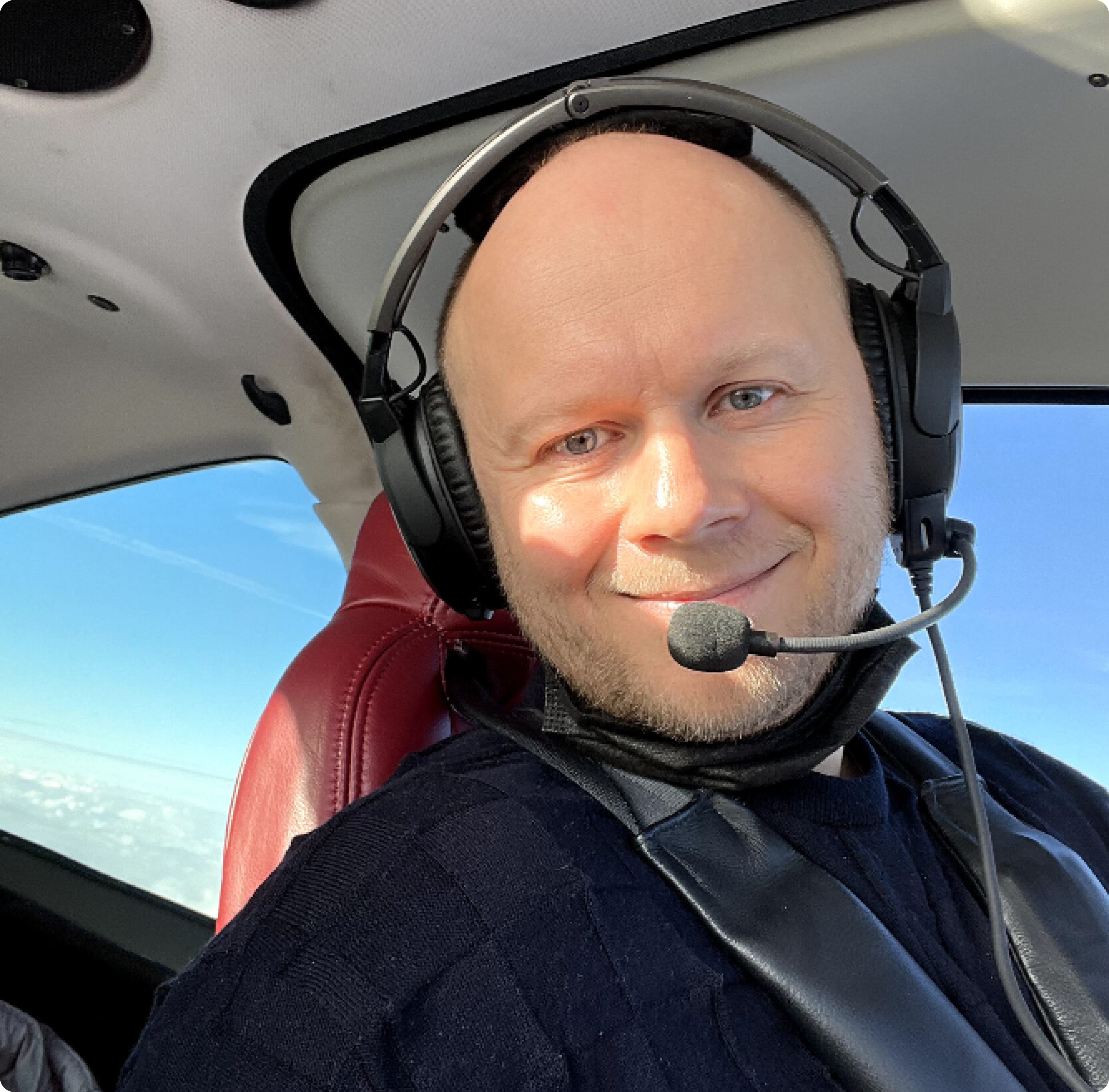
"Fear of flying is not about flying - it is about what happens in your nervous system. Your body is trying to protect you. It is doing its job brilliantly. The problem is that it is responding to a situation that is actually safe." - Alex Gervash, Pilot & Fear of Flying Therapist
This is why the techniques in this guide focus on body-based regulation - working with your nervous system rather than against it. As a commercial pilot for 31 years and a psychologist specializing in flight anxiety for 18 years, I have taught these techniques to over 16,000 people. They work.
Understanding Your Panic Response on a Plane
What Is Actually Happening in Your Body
When anxiety hits during a flight, your body launches a coordinated survival response:
- Heart racing: Adrenaline increases heart rate to prepare muscles for action (running or fighting).
- Shallow, rapid breathing: Your body tries to take in more oxygen for the anticipated physical effort.
- Sweating: Your body cools itself in preparation for exertion.
- Tingling or numbness: Blood flow redirects from extremities to major muscle groups.
- Nausea or stomach upset: Digestion shuts down because it is not a priority during a "threat."
- Tunnel vision or derealization: Your brain narrows focus to the perceived threat.
- Urge to escape: The most distressing symptom on a plane - your body wants to flee, but you cannot.
The important truth: Every single one of these symptoms is your body functioning correctly. It is a perfectly healthy survival response - just one that is misfiring because the situation is actually safe. Understanding this does not stop the symptoms, but it can prevent the secondary panic - the fear of the fear itself - which is what often makes things spiral.
Why Panic Attacks on Planes Feel Worse
Panic attacks can happen anywhere, but several factors make planes feel particularly intense:
- No exit: The inability to leave intensifies the trapped feeling.
- Unfamiliar sensations: Engine sounds, vibrations, and movement provide constant novel stimuli for an alert nervous system.
- Loss of control: You are not the pilot. You cannot pull over.
- Social pressure: Fear of embarrassment adds another layer of anxiety.
- Altitude awareness: Knowing you are 35,000 feet up amplifies the perceived stakes.
Knowing why your panic feels so intense on a plane can help you respond to it with understanding rather than more fear. Now let us move to what actually works.
Technique 1: The 4-7-8 Breathing Method
This is the single most effective in-the-moment technique I teach. It works because it directly stimulates the vagus nerve - the body's built-in calming system.
How to Do It
- Inhale through your nose for 4 seconds. Fill your belly, not your chest.
- Hold your breath for 7 seconds. This is the key - the hold activates the vagus nerve.
- Exhale slowly through your mouth for 8 seconds. Make the exhale longer than the inhale. This signals safety to your nervous system.
- Repeat 3-4 times.
Why it works: The extended exhale activates the parasympathetic nervous system (the "rest and digest" system). It is the physiological opposite of the fight-or-flight response. Within 60-90 seconds, most people feel a measurable shift - heart rate slows, muscles begin to relax, and the sense of panic starts to recede.
Pro tip: Practice this at home before your flight. If the 7-second hold is too long, start with 4-4-6 and work up. The principle is the same: exhale longer than you inhale.
Technique 2: The 5-4-3-2-1 Grounding Method
When panic narrows your world to the fear inside your head, grounding pulls you back to external reality. This technique uses your senses to anchor you in the present moment.
How to Do It
- 5 things you can SEE: The seat in front of you, the window, the flight attendant, the overhead light, your hands.
- 4 things you can TOUCH: The armrest, the texture of your clothing, the cool air from the vent, the seat belt buckle.
- 3 things you can HEAR: The engine hum, the cabin ventilation, someone speaking nearby.
- 2 things you can SMELL: Coffee from the galley, the fabric of your seat.
- 1 thing you can TASTE: Drink some water, have a mint, or simply notice the taste in your mouth.
Why it works: Sensory input from the present moment competes with the threat signals in your amygdala. By filling your brain with real sensory data, you disrupt the anxiety loop. It is not distraction - it is neurological redirection.
Technique 3: Peripheral Vision Activation
This is a lesser-known but powerful technique grounded in Polyvagal Theory.
How to Do It
- Fix your gaze on a point straight ahead (the seat in front of you).
- Without moving your eyes, expand your awareness to your peripheral vision - notice what is to the left and right of your focal point.
- Hold this expanded awareness for 30-60 seconds.
Why it works: Tunnel vision is a hallmark of the fight-or-flight state - your brain narrows focus to scan for threats. By deliberately activating peripheral vision, you signal to your nervous system that there is no immediate threat to focus on. This can shift your autonomic state surprisingly quickly.
Technique 4: Cold Water or Ice Activation
This technique uses the dive reflex - an ancient mammalian response that automatically slows heart rate.
How to Do It
- Ask the flight attendant for a cup of ice water.
- Hold the cold cup in your hands, press it against your wrists, or splash cold water on your face (use a napkin dampened with cold water).
- If you have ice, hold a piece in your hand and squeeze it.
Why it works: Cold stimulation activates the vagus nerve through the dive reflex, triggering an automatic parasympathetic response. Your heart rate can drop noticeably within seconds. This is one of the fastest interventions available.
What to Do During Turbulence
Turbulence is the number one trigger reported by fearful flyers. As a commercial pilot, I want to tell you what I know from the cockpit:
Turbulence has never caused a modern commercial aircraft to crash. This is not reassurance - it is an aviation safety fact verified by FAA and NTSB data. Aircraft are certified to withstand forces 1.5 times greater than any turbulence ever recorded.
During Turbulence, Do This
- Plant your feet firmly on the floor. Press them down. This grounds your body and gives your nervous system a sense of stability.
- Release your grip on the armrests. Counterintuitive, but gripping tightens your whole body and amplifies the threat signal. Open your hands, place them palm-down on your thighs.
- Start the 4-7-8 breathing immediately. Do not wait for the turbulence to pass - start breathing through it.
- Watch the flight attendants. If they are calm, working, or chatting, the turbulence is routine. Pilots and cabin crew experience turbulence every single day. It is not an event for us - it is weather.
- Open the SkyGuru app if you have it. It will show you what type of turbulence you are experiencing, how long it is likely to last, and what the pilots are doing about it - in real-time, with no internet needed.
"In 31 years of flying, I have never been concerned by turbulence. Not once. It is exactly like a bumpy road - uncomfortable, sometimes annoying, but never dangerous. Your nervous system disagrees with this, and that is what we need to work on." - Alex Gervash
What NOT to Do on a Plane
Some common coping strategies actually make anxiety worse:
- Do not grip the armrests: Muscle tension amplifies the fight-or-flight signal. Open your hands instead.
- Do not try to distract yourself with movies: Distraction only works until turbulence hits or your brain breaks through. It does not regulate your nervous system.
- Do not drink alcohol to calm down: Alcohol is a depressant that actually increases anxiety as it wears off. It also dehydrates you at altitude, making physical symptoms worse.
- Do not monitor every sound and movement: Hypervigilance keeps your amygdala activated. If you catch yourself scanning for danger, redirect to the 5-4-3-2-1 grounding technique.
- Do not fight the anxiety: Resistance creates more tension. Acknowledge what you feel: "My body is having a stress response. This is uncomfortable but not dangerous."
Using Technology for Real-Time Support
SkyGuru App: Your Pocket Pilot
The SkyGuru app was designed specifically for moments when you need answers fast. It works completely offline during your flight and provides:
- Real-time turbulence explanation: What type it is, why it is happening, and when it will end.
- Sound identification: What that noise was (landing gear, flap movement, engine power change).
- Flight phase guidance: What is happening at each stage and what to expect next.
- Guided anxiety exercises: Audio-guided breathing and regulation techniques timed to flight phases.
SkyBuddy: A Real Expert in Your Pocket
If you need human support, SkyBuddy connects you with a real fear of flying specialist who texts with you throughout your flight. Unlike an app, a human expert can respond to your specific fears in real-time, adjust their approach to what you need, and provide the kind of reassurance that only another person can offer.
When to Consider Professional Help
The techniques in this guide are effective for managing anxiety in the moment. But if you find yourself:
- Avoiding flights entirely
- Experiencing panic attacks before or during every flight
- Spending days or weeks dreading an upcoming flight
- Needing alcohol or medication to fly at all
Then in-the-moment techniques alone are not enough. You need treatment that addresses the root cause. Take our free 8-question assessment to understand your anxiety level and get personalized recommendations.
"Managing symptoms during a flight is important. But the real goal is to rewire your nervous system so it stops sending false alarms in the first place. That is what therapy does - it teaches your body, not just your mind, that flying is safe." - Alex Gervash
A Note on Medication
Many fearful flyers ask about medication. Here is my honest perspective as both a pilot and a psychologist:
- Anti-anxiety medication (benzodiazepines like Xanax): Can reduce acute symptoms but does not teach your nervous system anything. The fear remains unchanged for the next flight. Long-term use creates dependence.
- Beta-blockers (propranolol): Block the physical symptoms (racing heart, trembling) without the sedation. Can be useful as a bridge while doing therapy, but again - does not treat the underlying fear.
- SSRIs (for generalized anxiety): May help if flight anxiety is part of a broader anxiety pattern. Requires ongoing use and medical supervision.
My recommendation: medication can be a useful short-term tool, but it should never be your only strategy. Combine it with the techniques in this guide and, ideally, professional treatment that addresses the root cause.
Frequently Asked Questions
How do I stop a panic attack on a plane?
Start with the 4-7-8 breathing technique immediately: inhale for 4 seconds, hold for 7, exhale for 8. This activates the vagus nerve and shifts your nervous system from fight-or-flight to calm within 60-90 seconds. Follow with the 5-4-3-2-1 grounding method. Do not fight the panic - acknowledge it ("my body is having a stress response, this is uncomfortable but not dangerous") and focus on your exhale. If available, use the SkyGuru app for real-time flight information or SkyBuddy for live expert support.
What helps with turbulence anxiety?
Plant your feet firmly on the floor, release your grip on the armrests (open your hands, palms down on your thighs), and start 4-7-8 breathing immediately. Watch the flight attendants - their calm demeanor is genuine. Remember that turbulence has never caused a modern commercial aircraft to crash (FAA/NTSB data). The SkyGuru app can show you in real-time what type of turbulence you are experiencing and when it will end.
Should I take medication for flight anxiety?
Medication can reduce acute symptoms but does not teach your nervous system that flying is safe, so the fear returns on the next flight. Beta-blockers can block physical symptoms without sedation and may be useful as a bridge during therapy. Anti-anxiety medications like benzodiazepines carry dependence risks with regular use. The most effective approach combines short-term medication (if needed) with body-based techniques and professional treatment that addresses the root cause.
Can breathing exercises really help with flight anxiety?
Yes, and there is strong physiological evidence for why. Extended exhale breathing (like the 4-7-8 technique) directly stimulates the vagus nerve, activating the parasympathetic nervous system - the biological opposite of the fight-or-flight response. This is not a placebo effect; it is a measurable shift in autonomic nervous system state. Most people feel a noticeable reduction in heart rate and anxiety within 60-90 seconds. The key is making the exhale longer than the inhale.
Why does anxiety feel worse on a plane than anywhere else?
Several factors combine: you cannot exit (triggering trapped feelings), unfamiliar sensations constantly stimulate an alert nervous system, you have no control over the situation, social pressure adds fear of embarrassment, and awareness of altitude amplifies perceived danger. These factors create a perfect storm for the nervous system. However, this does not mean planes are actually dangerous - it means your nervous system is responding to the context, not the reality.
What should I do if my child is scared on a plane?
Children mirror their parents' nervous systems, so regulate yourself first using the breathing techniques. Then help your child with age-appropriate grounding: play "I spy" (visual grounding), let them hold something comforting, explain sounds simply ("that is the wheels going up, like a car putting away its tires"), and validate their feelings ("it is okay to feel nervous, lots of people do"). Never dismiss their fear with "there is nothing to be scared of" - their nervous system is telling them otherwise.