It's Not as Close as It Looks
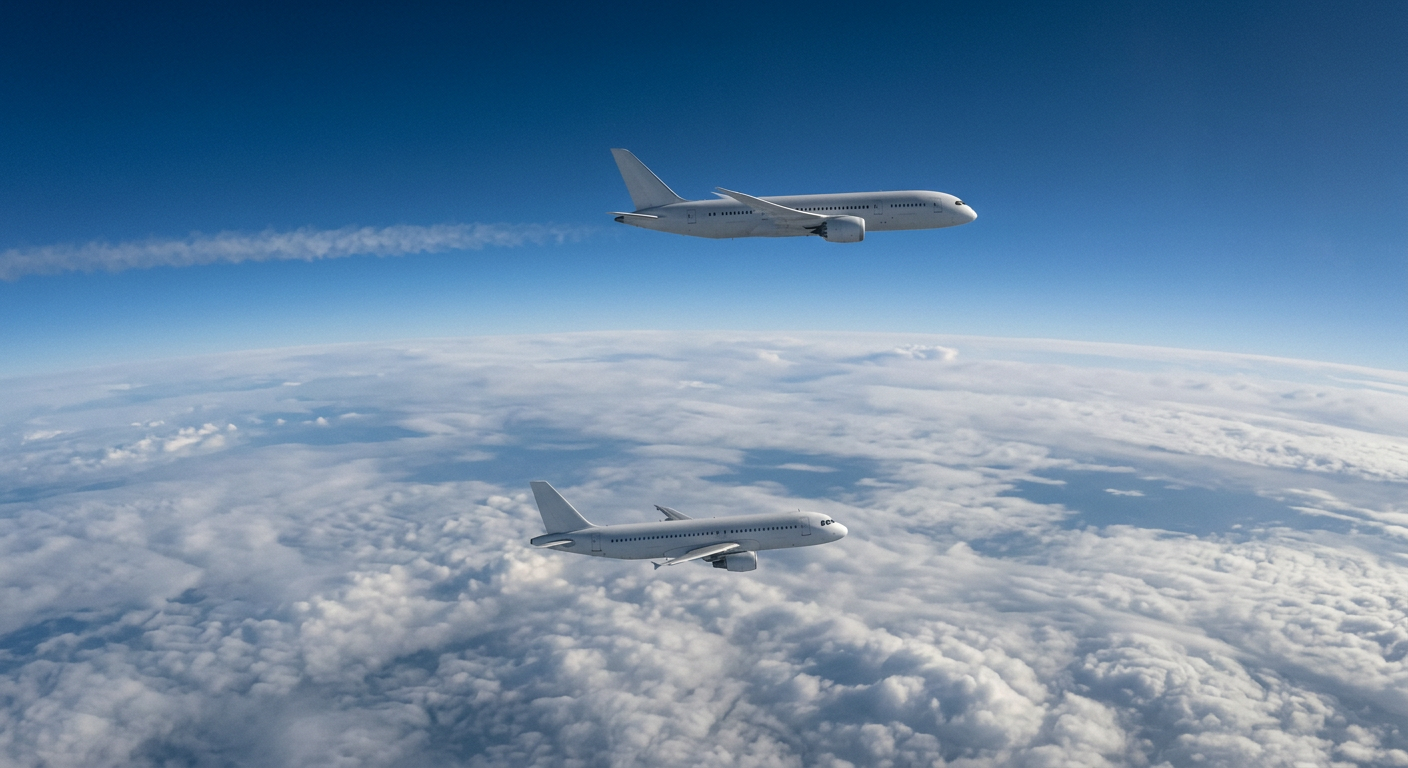
Today I want to tell you about why airplanes fly "so close to each other" in the sky. It might seem like this could be very dangerous, right?
But in reality, things are not as they appear. The fact is that airspace is vast, and in order to use it most efficiently, airplanes fly at certain altitudes and maintain strictly defined vertical and horizontal distances from each other.
The Safety Standards
Of course, there are specific safety rules and standards that must be followed:
- If airplanes are flying at the same altitude, the distance between them must be no less than 5 kilometers
- If their altitudes differ, the vertical distance must be at least 300 meters
TCAS: Your Guardian in the Sky
Moreover, airplanes are equipped with special safety systems that help them avoid collisions with each other. For instance, the TCAS (Traffic Collision Avoidance System) detects the proximity of other aircraft and can even automatically alter the flight path to avoid a collision.
Additionally, the main task of air traffic controllers is to separate air traffic to prevent dangerous proximity between aircraft. They are also assisted by computer systems that alert them to any potential close encounters.
Flight Level Rules
Furthermore, opposing airplanes always fly at different flight levels: for example, those flying in easterly directions will fly at odd levels (33,000 feet, 35,000 feet, 37,000 feet, and so on). Planes flying on westerly courses will fly at even levels (32,000 feet, 34,000 feet, 36,000 feet, etc.).
In the vicinity of airports, airplanes fly according to standard patterns: there are separate procedures for landing approaches, departures, and go-arounds, and these procedures never intersect.
For all these reasons, airspace is used clearly and safely.