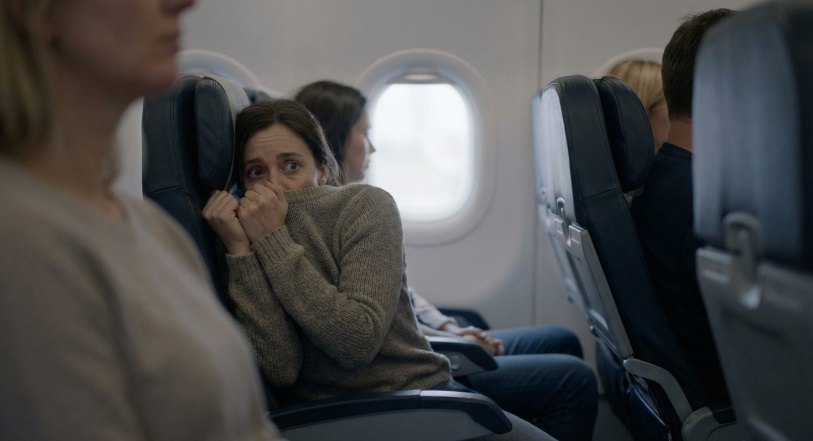
You are not crazy. You are not weak. Your nervous system is not broken. It is doing exactly what it was designed to do. Your alarm system is not malfunctioning. It is just being triggered in a situation where there is no actual danger.
I have spent eighteen years as a fear of flying specialist, and before that I spent over a decade in cockpits. I have seen fear from both sides. What I have learned is that fear of flying is almost never about flying.
Let me say that again because it is the most important sentence in this entire article. Fear of flying is almost never about flying. It is about your nervous system, your history, and the way your body learned to protect you long before you ever stepped onto an airplane.
The Three States of Your Nervous System
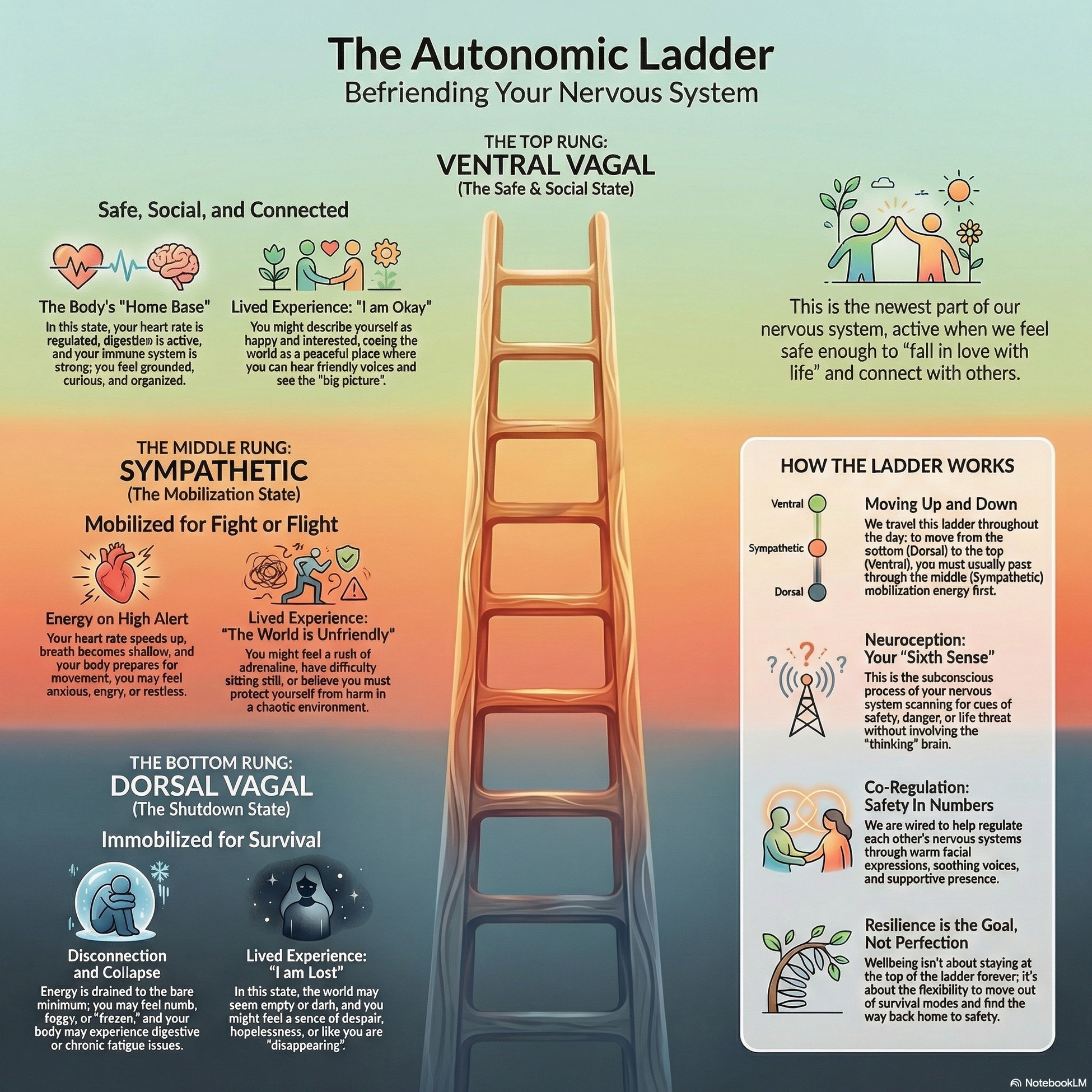
Professor Stephen Porges, who developed the Polyvagal Theory, described three states that your autonomic nervous system can be in at any given moment.
Ventral vagal is your safe and social state. When you are here, you feel connected. You can think clearly. You can assess risk accurately. If you were in this state on an airplane, you would notice the turbulence, shrug, and go back to your book.
Sympathetic activation is your fight-or-flight state. Your heart rate increases. Your breathing becomes shallow. Your muscles tense. Your thinking brain goes partially offline. This is the state most fearful flyers enter during takeoff, turbulence, or landing.
Dorsal vagal is shutdown. Freeze. Collapse. On an airplane, this can look like going completely numb, feeling disconnected from your body, or feeling like you are watching yourself from the outside.
You cannot choose which state you are in. Your nervous system decides based on its own assessment of the situation. Porges calls it neuroception.
Why Your Neuroception Gets It Wrong
Your neuroception is not evaluating whether flying is statistically safe. It is evaluating whether the current situation matches any pattern your body has ever associated with danger. This is pattern matching, not risk assessment.
Think of your amygdala as a barcode scanner. It scans every sensation and compares it against a database of past experiences. If it finds a match with something that was once threatening, it fires the alarm.
An airplane cabin has many features that can trigger false matches. You are enclosed in a space you cannot leave. You are not in control. You are surrounded by strangers. You are experiencing unusual physical sensations. For someone whose nervous system learned early in life that these conditions equal danger, the airplane is a perfect storm of triggers.
The Window of Tolerance
Dan Siegel introduced the concept of the Window of Tolerance. It describes the zone within which your nervous system can handle stress without flipping into fight-flight or shutdown.
People with a history of trauma often have a very narrow window. A small bump in the air, a strange noise from the engine, or the seatbelt sign turning on can be enough to push them outside of it.
The good news is that the window can be widened. This is the primary goal of therapy. Not to eliminate fear, but to widen the window so that you can tolerate more sensation, more uncertainty, more discomfort, without losing access to your thinking brain.
Why Logic Fails
You have probably read the statistics. You know that flying is the safest form of transportation. And it does not help. This is because fear of flying does not live in the part of your brain that processes logic. It lives in the limbic system and the brainstem.
Telling your amygdala that flying is safe is like telling a smoke detector to stop beeping by showing it a fire safety report. The smoke detector does not read reports. It detects smoke.
What Actually Works
Somatic Experiencing, developed by Dr. Peter Levine, works with the body's stored survival energy. When a threat response is activated but never completed, the energy gets stuck. Somatic Experiencing helps release that stuck energy.
EMDR helps process traumatic memories that are fueling the fear. Many people have a specific event, often from childhood, that created the template for their fear.
Polyvagal-informed techniques work directly with the autonomic nervous system to help you move from sympathetic activation back to ventral vagal safety.
Your Body Is Trying to Help You
Your fear of flying, as painful and limiting as it is, started as protection. The fear is not your enemy. It is a guard dog that is barking at the mailman. Your job is not to kill the guard dog. Your job is to teach it the difference between a real threat and a false alarm.
Your nervous system learned to be afraid. It can learn to feel safe. That is the work. And you do not have to do it alone.