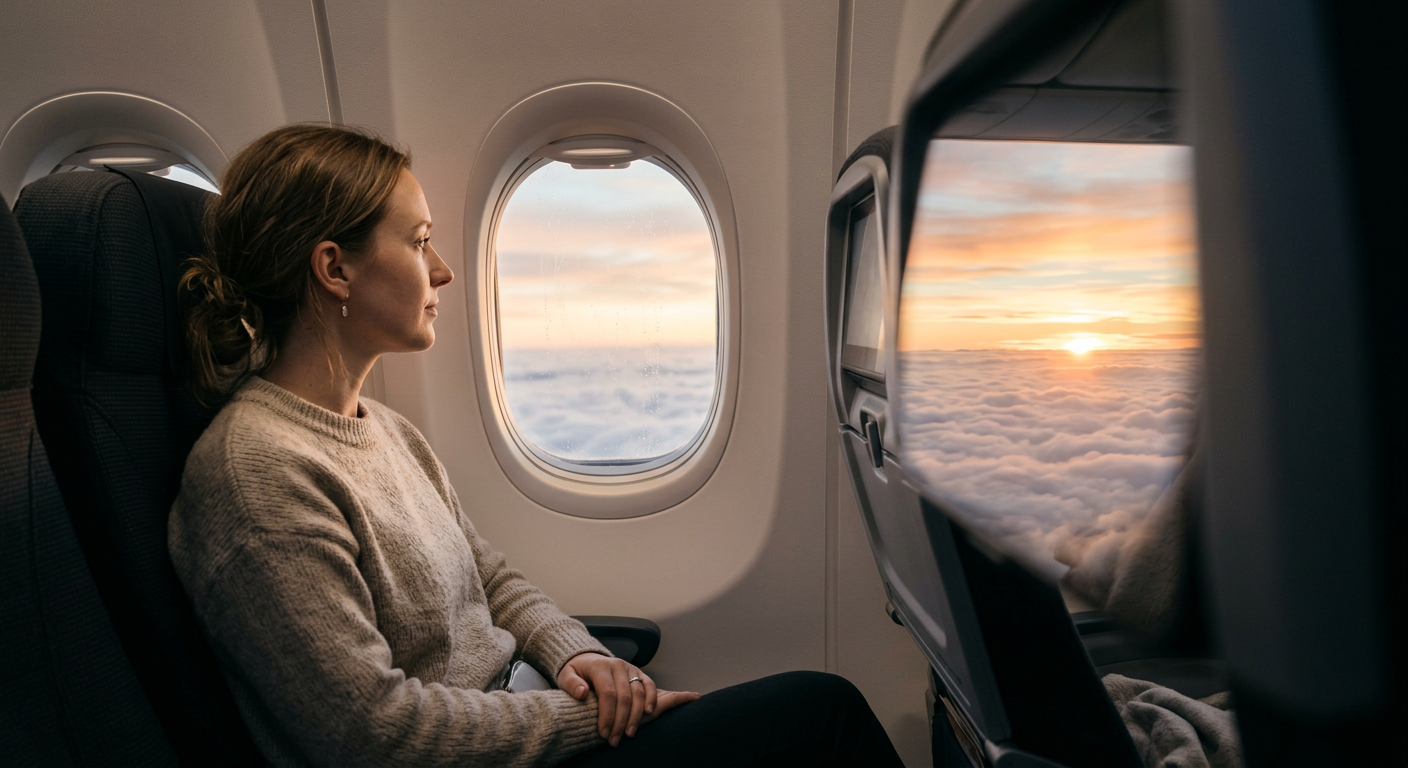
Last week, a woman told me she booked a flight to her daughter's wedding in Barcelona. Then she cancelled it. Then she booked it again. Then she cancelled it again. Three times in two days.
Her hands were shaking when she told me this over Zoom. She is a successful attorney. She runs a team of twelve. She handles courtroom pressure without blinking. And yet, the thought of boarding a plane turns her into someone she doesn't recognize.
I've heard this story hundreds of times. I hear it because I'm one of very few people in the world who does two things: I fly commercial aircraft, and I treat fear of flying as a clinical psychologist. I see the problem from both seats.
Here's what I've learned after 16 years of treating flight anxiety.
Your fear makes perfect sense
Your fear of flying is a completely normal reaction of a healthy nervous system. It works exactly as designed. The problem is context.
Your brain has an alarm system that operates 75 milliseconds faster than your conscious mind. Four times faster than you blink.
When you step on a plane and the door closes, your alarm system registers signals: you're enclosed, you can't leave, the floor vibrates, there are strange sounds, and the ground disappears beneath you.
Your ancient brain doesn't care about statistics. It responds to physical signals. And the signals in an airplane overlap with danger signals your ancestors needed to survive.
So it dumps adrenaline. Your heart pounds. Palms get wet. Mouth goes dry. Stomach clenches.
All of this is your body trying to save your life. The problem is the job is no longer relevant to the situation.
The espresso cup: why your fear keeps growing
Flight anxiety feeds itself. Imagine a tiny espresso cup.
Your nervous system pours the first shot of adrenaline when you hear the engine. 20ml. Then you grip the armrest - brain reads that as confirmation you're falling. 40ml. Then you rationalize - remember crashes, check weather. 80ml. Then check the flight attendant's face. 160ml. Cup overflows. Full panic.
Every action you took to protect yourself made it worse.
All safety behaviors (grabbing, checking, rationalizing, choosing "safe" airlines, drinking before boarding) send one signal: I am in danger.
The 90-second truth
A normal emotion, if you don't fight it, lives in your bloodstream for about 90 seconds. Adrenaline enters, cortisol follows. If you let them be without adding fuel, they metabolize in a minute and a half.
The 40-minute panic attack is 40 minutes of adding espresso to the cup. Each action restarts the 90-second clock.
What if you did nothing? What if you let the heart pound, palms sweat, stomach clench, and said: "OK. This is adrenaline. My nervous system is doing its thing. Thank you. I'll wait."
This is not positive thinking. This is physiology.
What to actually do on your next flight
Before the flight: Stop researching crash statistics. Stop checking weather. Stop choosing seats based on survival. You don't research survival rates of restaurant tables.
At the gate: When anxiety rises, don't fight it. Notice it. Keep hands open. Open palms tell your brain: I'm not falling.
During takeoff: The sensations are physiologically almost identical to a roller coaster or seeing someone you're attracted to. Same adrenaline, same heart rate. Only the label differs.
During turbulence: Turbulence has never brought down a modern commercial aircraft. From the cockpit, it's a comfort issue. Try belly breathing with a low humming sound - like a foghorn. This activates your vagus nerve. Four seconds in through nose, six seconds out through mouth with low hum.
The SkyGuru approach: I built SkyGuru app that explains what's happening in real time during flight. Every sound, movement, phase explained by a pilot. When you know that the "bang" is landing gear retracting, the mystery dissolves.
The real question
Getting over fear of flying means your nervous system will still react. That's fine. The real shift is learning to fly with the fear present, without fighting it, without feeding it.
The attorney? She's flying to Barcelona next month.
The goal isn't to fly without fear. The goal is to fly without the war against it.
Take a look at SkyGuru app or the School of Calm Flight programs. You don't need to be brave. You need to be informed. The bravery part takes care of itself.