Understanding why the amygdala hijacks your brain 80x faster than logic can respond—and why you can't think your way out of panic.
Understanding the Takeover
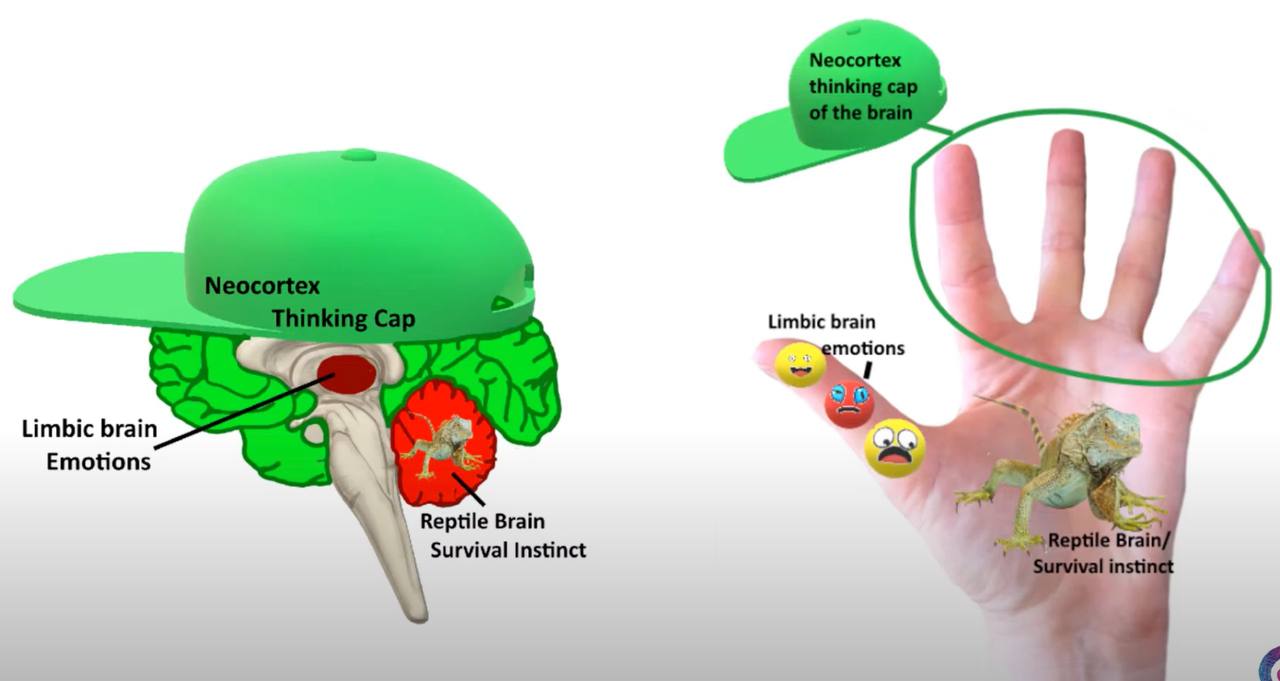
To understand why you panic, look at your hand.
The Wrist (Reptilian Brain): Responsible for basic survival (heart rate, breathing).
The Thumb (Limbic System): The emotional center, housing the Amygdala (the alarm bell) and the Hippocampus (memory).
The Fingers (Frontal Cortex): The logical, thinking brain that covers the thumb.
In a calm state, your "fingers" are down, and your logic is in control. But here is the critical design flaw: The Amygdala reacts to a threat in 4 milliseconds. The logical Frontal Cortex takes 320 milliseconds to process the same information.
When the Amygdala senses a threat (even a false one), it disconnects the Frontal Cortex before you can think "I am safe." You flip your lid. Your logic goes offline.
This is why you cannot "think" your way out of a panic attack. You are not stupid or weak; you are simply in a biological survival mode that is faster than your ability to reason.
In Short
Understanding why the amygdala hijacks your brain 80x faster than logic can respond—and why you can't think your way out of panic.
Trained in psychology and trauma therapy (EMDR, Somatic Experiencing)
Founder of phobia.aero & SkyGuru App
Alex Gervash leverages 31 years of commercial pilot experience and specialized psychology and trauma therapy expertise to help the nervous flyer regain control. Having assisted over 16,000 individuals with airplane phobia, he addresses aviation anxiety through a unique pilot perspective combined with evidence-based techniques like EMDR therapy. As the creator of the SkyGuru app, which provides flight comfort to over 200,000 users, Alex is a global leader in transforming flight panic into calm. His professional background allows him to deconstruct turbulence fear, helping passengers understand the mechanics of flight while managing the physiological roots of their distress.