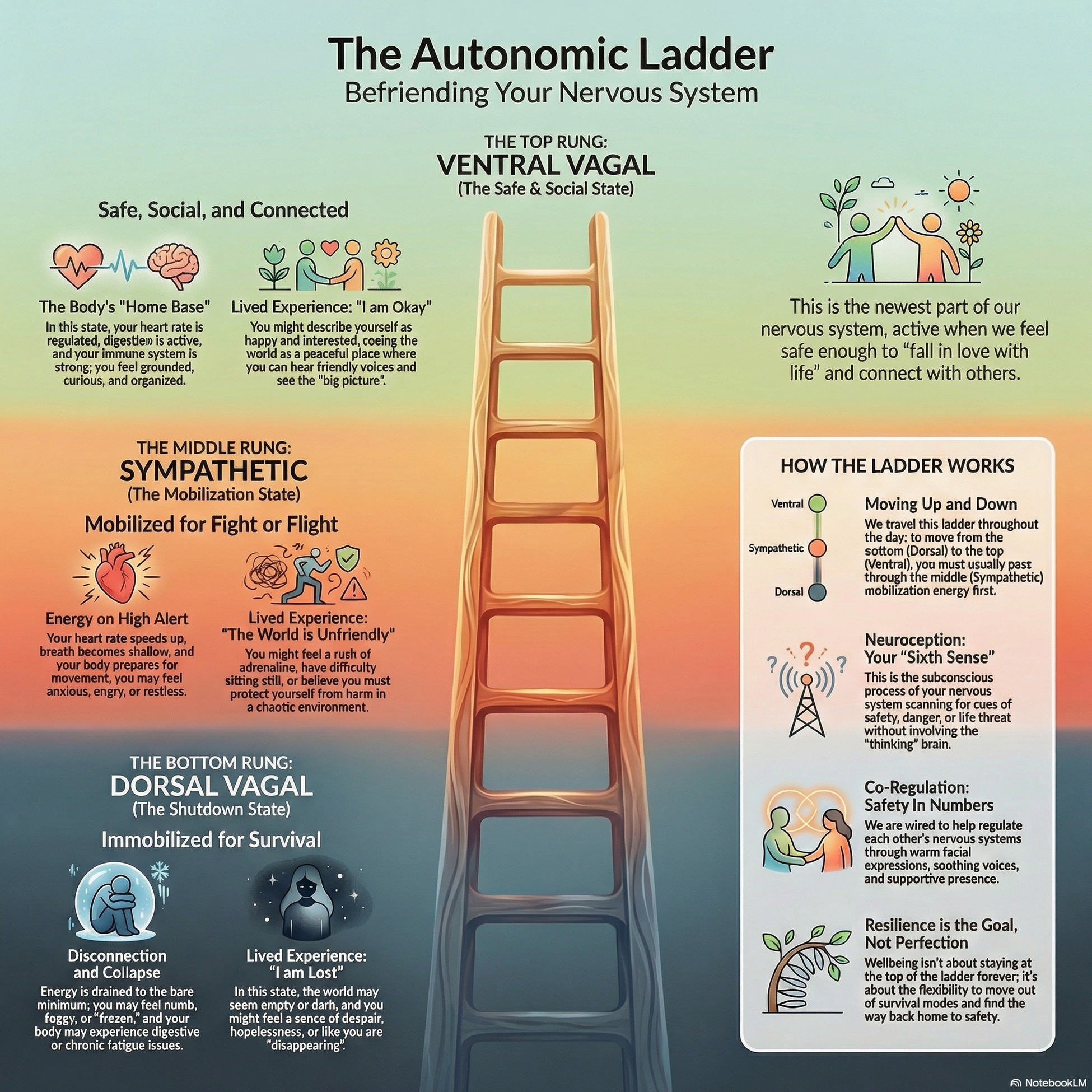
🪜 Imagine your nervous system as a ladder with three rungs:
TOP RUNG - Ventral Vagal (Safety Zone): "I'm safe, I can connect with others, I can think clearly"
MIDDLE RUNG - Sympathetic (Mobilization Zone): "Danger! I need to run or fight!"
BOTTOM RUNG - Dorsal Vagal (Shutdown Zone): "I give up. I'm frozen. Nothing matters."
When fear of flying hits, you slide down this ladder FAST.
The key insight from therapist Deb Dana: You can't jump straight from the bottom to the top. You need to climb back up step by step.
If you're frozen (dorsal), you first need to wake up your body and move to sympathetic activation.
If you're in high anxiety (sympathetic), you need to:
- Gaze far away and leave your eyes at a single point, preferably on the horizon line
- Make your body looser and softer, as if you're sitting in a very comfortable recliner armchair
- If you speak - slow down, make your voice softer
- Breathe as slowly as you can, making exhales longer than inhales
The goal isn't to be perfectly calm on a flight.
The goal is to:
- ✓ Know which rung you're on
- ✓ Understand it's not dangerous, just uncomfortable
- ✓ Have tools to climb up, one rung at a time
Your nervous system isn't broken. It's doing exactly what it was designed to do - protect you from perceived danger.
Now you just need to teach it: The plane isn't the danger. The nervous system response IS.