When a parent comes to me with fear of flying, there is one question I almost always ask. When did this start for you? And more often than not, the answer traces back to childhood. A turbulent flight at age seven. A parent who gripped the armrest every time the plane moved. A grandmother who announced before every trip that she had updated her will.
Fear of flying is not genetic. But it is inherited. Not through DNA. Through behavior. Through the nervous system of the adults who raised you. Through the meaning they attached to perfectly normal sensations.
How Fear Takes Root in a Child's Brain
Children do not come into the world knowing what is dangerous. They learn it primarily from two sources: their own experiences and the reactions of their caregivers.
This is called social referencing. When a toddler falls down and looks at the parent before deciding whether to cry, that is social referencing. The child is reading the adult's face to determine whether what just happened is dangerous or not.
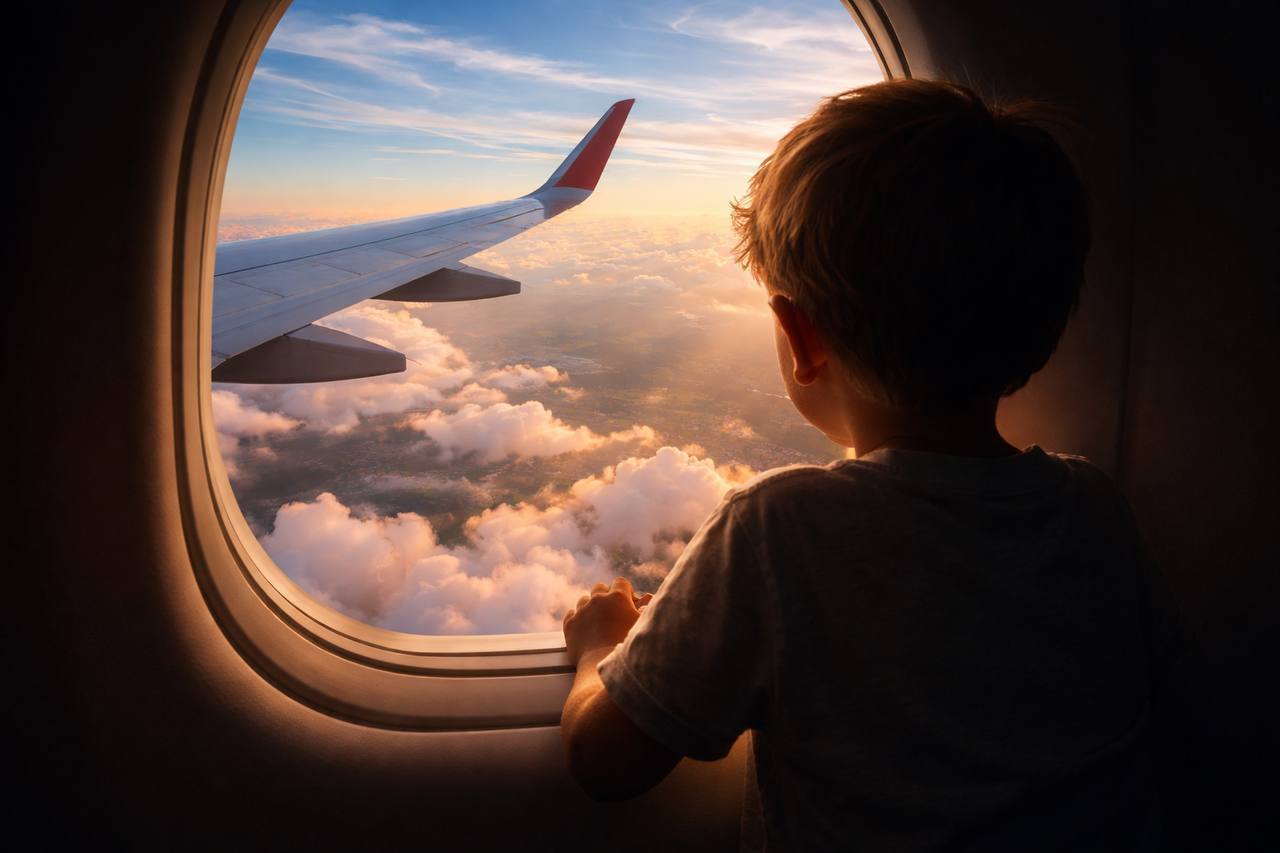
The same mechanism operates on airplanes. A child feels turbulence. The plane shakes. The child looks at the parent. If the parent's face shows terror, the child receives a very clear message: we are in danger.
The child's amygdala records the entire experience. The sounds of the engines. The feeling of the seatbelt. The physical sensation of being moved by turbulence. All of it gets tagged with one label: threat.
The Three Pathways of Childhood Flight Fear
The first pathway is direct transmission from a parent. A parent who is afraid of flying communicates that fear through body language, facial expressions, voice tone, and behavior. Children are exquisitely sensitive to the emotional states of their caregivers.
The second pathway is a traumatic direct experience. A child experiences severe turbulence, a go-around, or a hard landing that their nervous system interprets as life-threatening. The event does not need to be actually dangerous. It only needs to feel dangerous to the child.
The third pathway is indirect absorption through media, stories, or other people. A child watches a movie where a plane crashes. Children are not good at assessing probability. What they understand is that planes can fall out of the sky.
What Parents Get Wrong
Dismissing the fear. Telling a child there is nothing to be afraid of makes the child feel ashamed of the fear. Shame does not reduce fear. It drives it underground.
Over-accommodating the fear. Avoiding flying entirely sends a powerful message: flying really is dangerous. Avoidance is the fuel that keeps fear alive.
Providing excessive reassurance. Constantly telling the child everything is fine creates a dependency. Reassurance is a short-term solution that creates a long-term problem.
Forcing the child through the experience with no preparation can create a traumatic experience that deepens the fear.
What Actually Works
Validate the experience. "I can see that you feel scared. That makes sense. Your body is trying to protect you." This communicates that their experience is real and legitimate, without confirming that the danger is real.
Educate in age-appropriate ways. "The plane is designed to move in the air, just like a boat moves on water. When we feel bumps, that is the air pushing the plane around, like waves push a boat."
Prepare the nervous system. Practice belly breathing together at home. Make it a game. Do this daily for weeks before the flight.
Regulate yourself first. You cannot co-regulate a child's nervous system if yours is dysregulated. Children read nervous systems, not scripts. If your body is calm, your child will borrow that calm.
The Long View
Childhood fear of flying does not have to become adult fear of flying. The nervous system that learned to be afraid can learn to feel safe. If you are a parent reading this, the single most effective thing you can do for a fearful child on an airplane is to genuinely feel safe yourself.